

Personal Experience · Recovery
What It Was Really Like To Get A Hair Transplant In Turkey
Seven years of overthinking, and the thing I was most anxious about — the first 24 hours after surgery — turned out to be the most manageable part of the entire process.
I’m writing this because when I was researching my own hair transplant in Turkey, I could find plenty of before-and-after photos but very little honest detail about what those first hours actually feel like. What happens when the anaesthetic wears off? How sore is the donor area really? Can you sleep? Will you panic looking in the mirror?
This is everything I experienced from the moment I walked out of the operating room at Clinicana’s clinic inside Acıbadem Taksim Hospital to waking up the following morning — the good, the uncomfortable, and the parts nobody warns you about.
This article covers the immediate post-operative period: leaving the clinic, the walk back to the hotel, the first night’s sleep, medication, and what I felt physically and emotionally. For the full week-by-week recovery picture, see my complete aftercare guide.
Leaving the Clinic: What the First Moments Feel Like
The procedure finished at around 4:30pm. My 3,800-graft FUE had taken roughly six hours in total, including a lunch break. When the team started winding things down — cleaning the recipient area, applying a light bandage over the donor zone — I felt a genuine sense of disbelief that it was actually over.
They bandaged my head with a soft wrap that sat across the donor area at the back. The transplanted zone at the front was left open and visible — small red dots where each graft had been placed, arranged into my new hairline. It looked raw and a little alarming. That’s completely normal, but it was still a lot to process in a mirror for the first time.
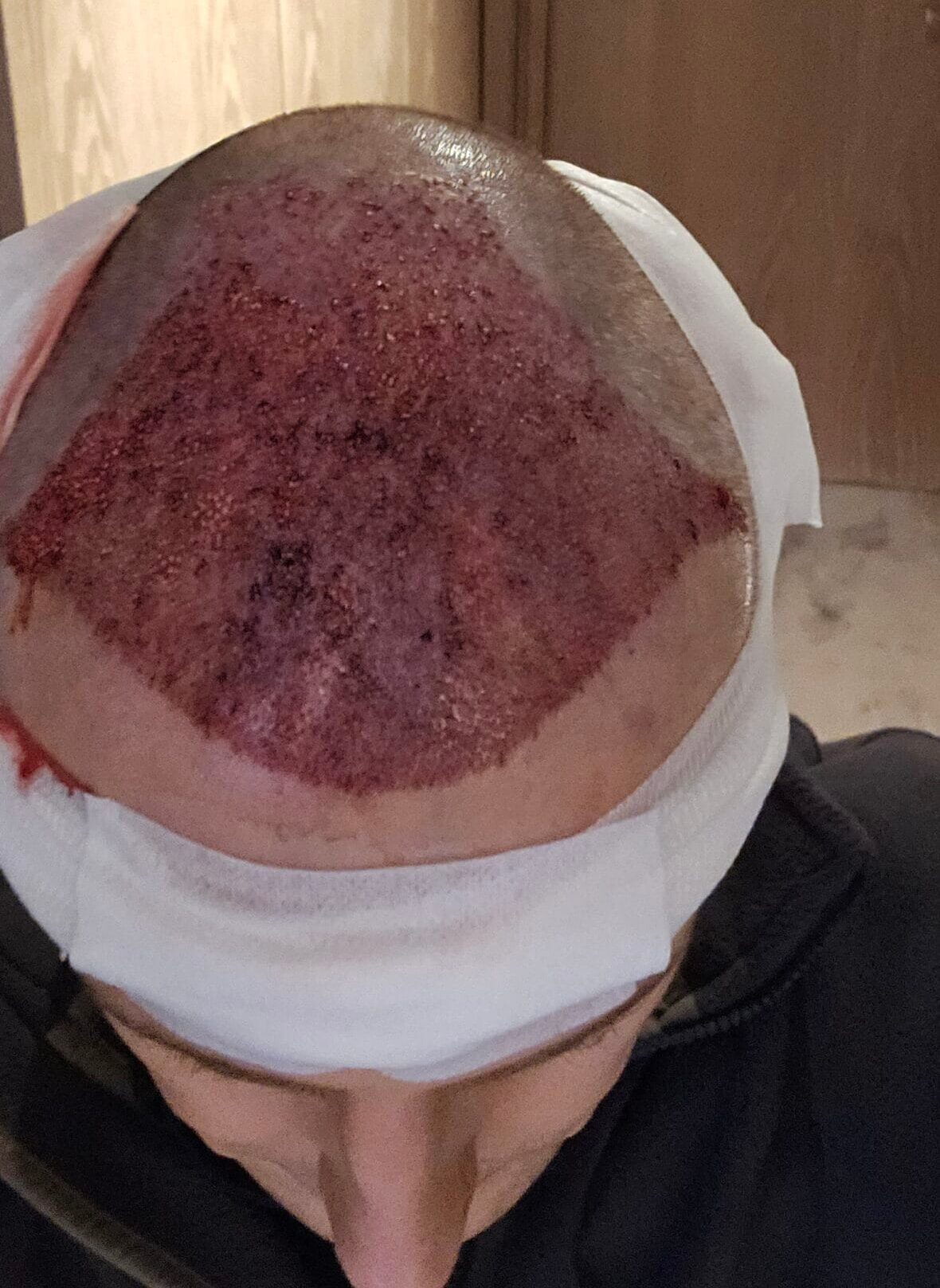
This is what my head looked like on the day of the procedure — the scabby, bloody appearance is completely normal and not painful at all.
The team spent about 30 minutes reviewing aftercare instructions with me — medication schedule, sleeping position, what to avoid, when to wash. There’s a lot of information coming at you when you’re also slightly dazed from six hours lying in a clinic, but the key points were written in the aftercare pack they handed me, so I didn’t need to memorise everything on the spot.
Then they said: “You can walk back to the hotel now.”
That struck me. No wheelchair, no waiting for a taxi, no recovery room. Just a gentle suggestion to put on a button-up shirt (less chance of catching the grafts than a pullover), a protective headband, and walk 150 metres down the street to the Naz City Hotel. And that’s exactly what I did.
If you’re travelling for a hair transplant in Turkey, pack at least three or four button-front shirts. Pulling a T-shirt or jumper over your head in the first two weeks is genuinely risky for the grafts. I wore button-ups the entire time I was in Istanbul and for the first week at home.
The Walk Back to the Hotel: Honest Impressions
Walking down a busy Istanbul street with a bandaged head and visible fresh grafts across your hairline is a slightly surreal experience. Istanbul is a city where people largely mind their own business, so I didn’t attract the stares I half-expected. A few people glanced; no one said anything.
Physically, I felt fine. Genuinely. The local anaesthetic was still doing its job — my scalp was numb, and the area that had received 3,800 grafts didn’t hurt at all. The donor area at the back felt like very mild sunburn: a warm tightness rather than pain. I took the walk slowly, not because I needed to, but because it felt wise not to rush.
What I noticed more than any physical sensation was the emotional weight of it. After seven years of putting this off, I had actually done it. The grafts were in. And now I had to get through the next 24 hours carefully enough not to disturb them.
The First Few Hours in the Hotel Room
I was back in my room by about 5:00pm. The hotel was clean, comfortable, and — crucially — very close to the clinic. If you’re planning your own trip and haven’t yet sorted logistics, I’d strongly recommend reading about the best areas to stay in Istanbul for hair transplant patients. Proximity matters when you’re heading back for your Day 2 wash and post-op check.
The first thing I did in the room was sit down and go through the medication pack properly. The anaesthetic was still active, so I didn’t feel any urgency — but I wanted to understand the schedule before I needed it.
Medication: What I Was Given and When I Took It
| Medication | Purpose | When I Took It | My Experience |
|---|---|---|---|
| Antibiotic (oral) | Prevent infection at extraction and implantation sites | With evening meal, Day 1 | No side effects |
| Anti-inflammatory | Reduce swelling, especially around the forehead | Evening, Day 1 | Important — I was glad I took this promptly |
| Paracetamol | Manage donor area discomfort | Before bed, Day 1 | Completely adequate — nothing stronger was needed |
I took mine promptly, which I believe helped. Patients who remove the headband too early or skip anti-inflammatories can end up with significant forehead swelling by Day 2 or 3. The headband is not optional decoration — it physically helps drainage away from the recipient area.
I also had the Xanax option available. The clinic had offered this during the procedure itself (I took it and found it genuinely helped with the six-hour stretch on the table), but they also mentioned it could help with sleep if anxiety was high. I didn’t end up taking it that night — the tiredness from such a long day made sleep come relatively easily.
When the Anaesthetic Started to Wear Off
This is probably the question I’d wanted answered most when I was researching. What actually happens when the local anaesthetic wears off after a hair transplant?
The honest answer: far less than I feared.
By about 7:00pm — roughly two to three hours after the procedure finished — I started to feel sensation return to my scalp. Not pain, exactly. More like a significant tightness in the donor area combined with a warm, sunburned feeling. Think of it like the aftermath of a severe sunburn rather than a wound. The recipient area at the front felt sensitive but not sore.
The paracetamol I took before bed dealt with the donor area discomfort completely. I didn’t feel any need for stronger pain relief, and nothing I experienced required me to contact the clinic or reach for emergency medication. By the time I fell asleep, the discomfort had settled into background noise rather than something demanding my attention.

Day 2 — the morning after surgery. The grafts are visible and intact. Some pinkness and small scab points are forming, which is completely normal.
Research supports this experience. FUE hair transplant procedures are associated with low post-operative pain levels because they don’t involve linear incisions or sutures. The donor sites are multiple tiny punch extractions that heal quickly. Most patients report discomfort rather than pain, and standard over-the-counter analgesics are sufficient.
Hour-by-Hour: How My First Evening Unfolded
-
5pm
~5:00pm
Back in the hotel room
Read through aftercare pack carefully. Took first round of medication. Headband still on. Scalp still numb from anaesthetic. Felt surprisingly calm.
-
6pm
~6:00pm
Ordered room service
I didn’t feel like going out or sitting in a restaurant with a bandaged head. Room service was the right call. Small meal — I wasn’t particularly hungry after the anxiety and long day.
-
7pm
~7:00pm
Anaesthetic wearing off
Sensation returning to scalp. Donor area felt tight and sun-warmed. Took paracetamol as instructed. Watched TV to distract myself. Nothing required urgent attention.
-
9pm
~9:00pm
Preparing for sleep
The most logistically tricky part of the evening. Setting up the sleeping position carefully (see below). Kept headband on as instructed. Genuinely more tired than anxious by this point.
-
AM
Next morning
Woke up intact
Slept longer than expected. Scalp still tender but manageable. Forehead slightly swollen (normal). Donor area felt like the day after a sunburn. Ready for Day 2 wash at the clinic.
The Sleeping Position: The Most Important Thing to Get Right
This is the part I was most anxious about, and probably the part that matters most in terms of protecting your grafts in the first 24 hours.
The instructions from Clinicana were clear: sleep on your back, head elevated at approximately 45 degrees, for at least the first five nights. This does two things. First, it keeps pressure off the donor area at the back of the head. Second — and more importantly — it uses gravity to direct any swelling away from the recipient area rather than pooling in the forehead and around the eyes.
The clinic provided a neck travel pillow for the flight home, which doubles as useful support for this sleeping position. I supplemented it with the hotel pillows stacked to create an incline. It felt awkward at first — I’m a side-sleeper by habit — but the exhaustion from the day meant I fell asleep faster than expected and didn’t toss around much.
Rolling onto the recipient area while grafts are in their most vulnerable state (the first 48–72 hours) risks physically dislodging them. The grafts are not yet anchored by new blood vessels during this window. Sleeping on your back is non-negotiable — even if you don’t find it natural.
I did wake up once in the night and found I’d moved slightly to one side. I adjusted immediately and tried not to panic about it. One small movement doesn’t dislodge grafts — the risk is sustained pressure rather than momentary contact. By morning, everything looked fine when I checked carefully in the bathroom mirror.
Practical Tips for the First Night’s Sleep
- Stack two to three pillows or use a wedge pillow to achieve the 45-degree incline
- Keep the headband on — removing it early increases swelling risk significantly
- Place a clean towel over your pillow in case of minor spotting from the donor area
- Don’t drink alcohol — it thins the blood and increases swelling and bleeding risk
- Keep the room cool — overheating causes sweating, which is bad for newly implanted grafts
- Have water and paracetamol within reach so you don’t have to rummage around at 3am
Swelling: What to Expect and When It Peaks
I want to be honest about swelling, because it caught me slightly off-guard on Day 2.
On the evening of Day 1, swelling was minimal. My forehead looked normal. I kept the headband on, took the anti-inflammatory as instructed, and went to sleep feeling relatively reassured. What I hadn’t fully registered was that swelling from a hair transplant doesn’t usually peak on Day 1 — it typically peaks on Days 3 and 4, and it moves downward due to gravity.
On Day 2, after I removed the headband briefly (the clinic demonstrated the next morning how to position it correctly), I noticed my forehead had started to puff slightly. By Day 3, there was more visible swelling that had descended slightly toward the brow. This is completely normal and expected — it’s the body’s inflammatory response, not a sign that anything has gone wrong. Ice packs applied gently around (not on) the recipient area helped significantly, as did continuing the anti-inflammatory course.
Clinical guidance on post-FUE recovery consistently identifies Days 3–4 as when forehead and periorbital (around the eye) swelling is most pronounced. It typically resolves by Day 5–7. If you have important plans or social commitments, factor this in before booking your surgery date.
What It Actually Looks Like: Managing Your Expectations in the Mirror
I want to talk about this because it’s something the clinics understandably don’t emphasise — the visual shock of seeing yourself in the first hours after a hair transplant.
Your recipient area will look raw. There will be small red dots or dark pinpoints where each graft sits. There may be some dried blood or light fluid around the follicles. The donor area at the back will be shaved and may have small marks where each extraction was made. You may have slight pinkness across both areas.
None of this is alarming from a medical standpoint. But it can be emotionally confronting, especially if you’ve been imagining the end result rather than the immediate aftermath. The before-and-after photos on clinic websites jump from “before” to “six months later” — they rarely show you what Day 1 looks like.
My advice: look in the mirror once, register what you see, remind yourself this is exactly what it’s supposed to look like, and then stop checking obsessively. There’s nothing useful you can learn from staring at it every thirty minutes.
Things That Helped (And Things I’d Do Differently)
What helped
- Taking the Xanax during the procedure. I was relaxed throughout a six-hour session. Time passed much faster than expected. I’d take it again without hesitation.
- Room service instead of going out. I was tired, my head was bandaged, and Istanbul’s busy streets weren’t where I wanted to be that evening. A quiet room was the right call.
- Taking medication promptly. Not waiting until the discomfort was bad before taking the anti-inflammatory and paracetamol. Getting ahead of swelling is far easier than managing it once it’s established.
- Preparing the sleeping setup before I was exhausted. I sorted the pillow arrangement while I still had energy and patience. Doing it half-asleep would have been frustrating.
- WhatsApp updates to the clinic. I sent a quick message saying everything felt okay and the coordinator confirmed what I should watch for overnight. That reassurance was worth a lot.
What I’d do differently
- Bring ear defenders or a sleep mask. The hotel was fine but Istanbul is a city that doesn’t go quiet. Protecting sleep quality in those first nights matters.
- Pack a cooler bag with ice packs. I had to ask the hotel for ice when swelling appeared. Having ice packs ready from the start would have been smarter.
- Not look in the mirror quite so many times on the first evening. Each mirror check added anxiety without adding information. The grafts looked the same each time. I should have been gentler with myself.
Expectations vs Reality: The Honest Comparison
| What I feared | What actually happened |
|---|---|
| Intense pain when the anaesthetic wore off | Mild tightness and warmth in the donor area. Paracetamol was more than sufficient. |
| Not being able to sleep at all | Slept reasonably well. Exhaustion from the long day helped. Woke once but settled again quickly. |
| Something going visibly wrong with the grafts | Everything looked exactly as described. No unexpected bleeding, no displaced grafts. |
| Significant swelling immediately | Minimal swelling Day 1. It built gradually over Days 2–4, which I hadn’t fully expected. |
| Feeling fragile and incapacitated | Walked back to the hotel unaided and felt physically capable the whole evening. |
| Regretting the decision immediately | Felt relieved and cautiously optimistic. The procedure being complete was a significant psychological weight lifted. |
The Morning After: What Changed Overnight
I woke up to the sound of the city outside and lay still for a moment before moving, conscious of not disturbing anything. My first action was to gently check that the headband was still in place. It was.
The donor area felt like the morning after a sunburn — improved from the previous evening but still present. The recipient area had some tightness but no significant pain. My forehead had started to swell very slightly at the brow. All of this was within what I’d been told to expect.
The clinic appointment for my first wash was at 9:00am, and that morning routine — walking those 150 metres back to Acıbadem Taksim Hospital — felt like a small milestone. The hardest part of the immediate post-operative period was behind me. The medical team checked everything, demonstrated the gentle washing technique I’d use at home for the following two weeks, and confirmed the grafts looked exactly as they should.
One of the underrated benefits of having your procedure at a clinic that does your first wash in-house is the reassurance of having a medical professional look at everything and confirm it looks normal. If you’re anxious overnight, holding that thought — that a professional will check everything in the morning — genuinely helps.
What to Avoid in the First 24 Hours
Beyond the obvious (don’t touch the grafts, don’t get them wet), these are the things worth actively avoiding in those critical first hours:
- Alcohol — increases bleeding risk, interferes with healing, and interacts badly with the antibiotics you’ll be taking
- Bending over sharply — increases blood pressure to the head and can cause minor bleeding at the recipient sites
- Strenuous activity of any kind — this is not the evening for a hotel gym session; blood pressure elevation can disturb the grafts
- Removing the headband — it’s there for a reason; wear it as instructed, typically for 72 hours
- Touching or inspecting the recipient area with your hands — even clean hands introduce bacteria and risk dislodging grafts
- Smoking — reduces blood flow to follicles during the critical establishment phase
- Hot showers or steam — heat increases swelling and the risk of follicle displacement through sweating
For everything that comes after these first 24 hours, I’d recommend reading my guide to hair washing, sleeping position and sun exposure after surgery, which covers the full first two weeks in detail.
A Note on Anxiety: The Emotional Side Nobody Talks About
I delayed my hair transplant for seven years, mostly because of anxiety — about choosing the wrong clinic, about the procedure itself, about what people would think. I want to say something directly to anyone who recognises that experience.
The first 24 hours after surgery is also emotionally complex. You’ve done something irreversible. The grafts are in. You look strange in the mirror. The results won’t be visible for months. You’re in a foreign city, possibly alone, with a bandaged head.
All of that is real, and you’re allowed to find it a lot to process. What helped me most was having something concrete to focus on: the medication schedule, the sleeping position, the WhatsApp check-in with the clinic. Structure reduces anxiety. If you go into the first 24 hours with a clear plan for each hour, it feels manageable rather than overwhelming.
If you’re in the research phase and trying to decide whether to take the step, read why I finally decided to get a hair transplant after 7 years of doubting it. The fears that kept me waiting were almost entirely unfounded.
What Comes Next
The first 24 hours is just the beginning. Here’s where to go next depending on what you want to understand:
More from my diary
For the bigger picture, see my hair transplant diary, which follows my journey stage by stage.
The washing, sleeping and sun rules set out what I was told to do day to day.
If it helps, my recovery timeline covers healing from the first days to a full year.
Also worth a look: my results timeline, which shows how my hair grew, month by month.
The psychological side of it covers how it affected the way I felt.
If it helps, why people regret a hair transplant in Turkey looks at the other side of the story.
Also worth a look: my trip planning guide, which covers flights, hotels and the days around the procedure.
My aftercare guide sets out what I was told to do afterwards.
 Continue with Google