Hair Transplant Turkey Experience: My Complete Guide With Real Results
This site documents one complete, real-world hair transplant experience in Turkey and connects that experience to verified medical facts.
Getting a hair transplant in Turkey offers a proven path to permanent hair restoration at 60-70% lower costs than UK or USA procedures according to Bravewords. Turkey has become a leading destination for hair transplants due to lower operating costs, high procedure volume, and medical tourism infrastructure. My January 2025 procedure aligned with these general cost and access patterns, but outcomes vary by clinic and patient. Istanbul clinics perform over 500,000-1million hair transplants annually according to aa.com.tr, using advanced FUE, DHI, and Sapphire techniques, with all-inclusive packages ranging from £1,500-£3,000 that include surgery, accommodation, transfers, and aftercare .
Quick Facts
Details
Average Cost
£1,500-£3,000 (vs £8,000-£15,000 UK according to aedit.com )
Primary Location
Istanbul hair transplant clinics
Top Methods
FUE, DHI, Sapphire hair transplant
Typical Grafts
2,000-5,000 hair grafts
Package Includes
Surgery, hotel (3-4 nights), transfers, medications, aftercare kit
Quick Answer: What You Need to Know
Cost savings: Turkey typically costs 60-70% less than Western countries for equivalent quality
Clinic expertise: Leading Turkish surgeons perform 4,700+ procedures annually vs 100-200 in UK/USA
Timeline: 4 days in Istanbul, visible results by 6 months, full density at 12-18 months
Hair Transplant in Turkey: Key Questions Answered
What is a hair transplant in Turkey?
A hair transplant in Turkey is a medical procedure where genetically resistant hair follicles are transferred from the donor area to thinning or bald areas, typically in Istanbul clinics performing high-volume FUE, DHI, or Sapphire techniques at lower costs than Western countries.
Hair transplant costs in Turkey typically range from £1,500 to £3,500 depending on technique, graft count, and clinic standards, with most all-inclusive Istanbul packages costing 60–70% less than equivalent UK or US procedures.
Hair transplants in Turkey are safe when performed in licensed clinics accredited by the Turkish Ministry of Health, using qualified surgeons and hospital-grade facilities, though outcomes still vary based on surgeon skill, planning, and patient biology.
There is no single best hair transplant method in Turkey; FUE suits large graft numbers, DHI offers higher placement precision for smaller areas, and Sapphire FUE provides marginal healing improvements, with surgeon experience mattering more than technique choice.
What can’t be guaranteed with a hair transplant in Turkey?
Even with experienced surgeons and modern techniques, hair transplants involve variables that no clinic can fully control. Growth speed, final density, healing response, and aesthetic perception differ between patients.
Who This Page Is For
This guide is for people seriously considering a hair transplant in Turkey who want honest, experience-based information about costs, safety, methods, and realistic expectations.
You’re a good candidate if:
You have stable hair loss patterns with sufficient donor hair
You’re 25+ years old with established balding patterns
You have realistic expectations about gradual results over 12-18 months
You’re in good overall health without conditions affecting healing
You should wait or consult a specialist if:
You’re under 25 with unstable hair loss
You’re experiencing sudden hair loss (could indicate medical issues)
You have active scalp conditions or insufficient donor hair
You have medical conditions requiring close local monitoring post-surgery
Hair Transplant Cost Comparison 2026
Understanding hair transplant costs in Turkey helps you make informed financial decisions. The price difference between Turkey and Western countries is substantial without compromising quality at accredited clinics.
Why Turkey Offers Better Value
Hair transplant costs in Turkey are significantly lower due to reduced operating expenses, high competition among many hair transplantation clinics, and volume efficiency. A surgeon in Istanbul might earn €80,000-150,000 annually versus €200,000-400,000 in London for equivalent expertise, and these savings transfer directly to patients.
Complete Cost Breakdown
Location
Average Cost
What’s Included
Package Details
Turkey (Istanbul)
£1,500-£3,000
Surgery, hotel (3-4 nights), transfers, medications, aftercare kit, follow-up support
All-inclusive packages with no hidden fees. Hotel typically 150m from clinic in Istanbul.
United Kingdom
£8,000-£15,000
Surgery only
Accommodation, medications, and follow-ups charged separately. Consultation fees often £100-500.
United States
$10,000-$20,000 ($8,200-£16,400)
Surgery only
Consultation charged separately. No accommodation or travel support.
Method-Specific Pricing in Turkey
FUE Cost: £1,500-£2,500 for up to 5,000 grafts
Sapphire Cost: £1,800-£2,800 (£200-500 premium over standard FUE)
While hair transplant packages in Turkey are genuinely all-inclusive, plan for:
Flights: £200-£400 return from UK to Istanbul
Evening meals: Hotels include breakfast but not dinner (£12-20 per meal)
Optional products: Hair growth serums or supplements (£50-90)
Travel insurance: £25-50 for medical tourism coverage
(The clinic mentioned below is referenced as part of my personal experience, not as a general recommendation and should not be interpreted as a price or outcome guarantee.)
Real-world example: My January 2025 FUE procedure at Clinicana cost £2,400 (€2,850). Adding £295 flights, £85 meals, and £75 optional serum brought my total to £2,855—still 64% less than the £8,000 cheapest UK option.
Hair Transplant Methods in Turkey
Turkish hair transplant clinics specialize in three primary techniques. Understanding the differences helps you choose the best method for your specific hair loss pattern and budget.
FUE Hair Transplant (Follicular Unit Extraction)
FUE is the most established hair transplant technique worldwide. Individual hair follicles are extracted from your donor area using micro-punch tools (0.7-0.9mm diameter), then implanted into recipient channels in thinning areas.
How it works: The surgeon extracts follicular units one by one from the back and sides of your head, stores them in temperature-controlled solution, creates recipient channels matching natural hair growth patterns, then carefully places each graft to achieve optimal hair density.
Key benefits:
Proven 85-95% graft survival rate when performed by experienced surgeons according to Hermestclinic.com
Minimal scarring (tiny dots invisible once surrounding hair regrows)
Most affordable option for large coverage areas
Suitable for male pattern hair loss and comprehensive restoration
Recovery timeline: Small dot scars in donor area heal within 7-10 days. Most people return to work after one week. Hair grafts enter shedding phase around month 2-3 before permanent regrowth begins.
Best for: Patients needing 2,500+ grafts for extensive coverage, those prioritizing proven results over premium methods, and anyone on a budget who still wants natural results.
I chose FUE for my 3,400-graft procedure in January 2025. My surgeon recommended it because covering my receding hairline required significant volume—DHI would have been unnecessarily expensive. Seven months later, the transplanted hair blends perfectly with my native hair.
Compared to DHI hair transplant: FUE works better for large areas requiring more grafts, while DHI offers precision advantages for smaller zones.
DHI Method (Direct Hair Implantation)
DHI uses a specialized Choi implanter pen that creates the recipient channel and places the graft in one motion, rather than FUE’s two-step process (create channel, then insert graft).
How it works: The hair transplant doctor loads extracted follicles into Choi pens with 0.6-1.0mm needles. Each pen simultaneously creates the channel and implants the hair follicle at precise angles and depths, giving maximum control over angle, direction, and placement.
Key benefits:
More precise control over each follicle’s angle and depth
Less time hair follicles spend outside the body (potentially higher survival)
Can be performed without shaving entire head (crucial for female hair restoration)
Creates denser, more natural-looking hair in concentrated areas
Drawbacks:
Requires more skill and time (typically 8-10 hours vs 6-8 for FUE)
More expensive (£2,500-£3,500 vs £1,500-£2,500 for FUE)
Not cost-effective for large areas needing 4,000+ grafts
Recovery timeline: Faster healing than FUE—most patients return to normal activities within 5-7 days. Less tissue trauma means reduced swelling and discomfort.
Best for: Hairline refinement requiring maximum precision, female hair transplants where avoiding full head shaving matters, thin hair patients needing concentrated density, and touch-up procedures for small areas.
Compared to Sapphire FUE: DHI offers superior precision but costs £700-1,000 more. Choose based on your specific needs, not marketing pressure.
Sapphire Method
Sapphire hair transplant is a refined version of FUE using sapphire-tipped blades instead of steel to create recipient channels. The harder, sharper blades theoretically create cleaner incisions for denser graft placement.
How it works: Identical extraction process to standard FUE. The only difference occurs during channel creation—sapphire blades maintain sharpness longer than steel, producing more uniform incisions that may allow slightly denser hair transplant result placement.
Marginally faster healing (5-8 days vs 7-10 for standard FUE)
Allows slightly higher density in recipient areas
Same proven FUE foundation with incremental improvements
Cost premium: Typically £200-500 more than standard FUE in Istanbul clinics. Some hair transplant clinics in Turkey include Sapphire at no extra cost.
Surgeon perspective: My surgeon at Clinicana told me Sapphire makes a marginal difference—nice to have but not essential (This reflects one surgeon’s professional judgment, not a consensus across all clinics or practitioners). The surgeon’s skill matters far more than blade material. He’s performed over 10,000 procedures and sees minimal outcome differences between standard and Sapphire FUE.
Best for: Patients wanting incremental improvements who can afford the modest premium, those with very fine hair where maximum density matters, and anyone choosing between standard FUE and Sapphire where clinic offers it at little cost difference.
Compared to standard FUE: Marginal improvements in healing time and potential density. Choose Sapphire if the cost difference is under £300 and your clinic has significant Sapphire experience.
Which Method Is Best?
There is no universally “best” method. Technique selection depends on graft count, donor quality, scalp characteristics, and long-term planning. A method that works well for one patient may be unnecessary or unsuitable for another.
FUE is commonly recommended for patients needing larger graft numbers due to cost efficiency and scalability, achieveing up to 85-95% graft survival with minimal scarring. DHI suits smaller areas requiring higher precision, while Sapphire method offers marginal improvements for a moderate cost increase.
Your surgeon should recommend based on your specific hair loss pattern, desired density, and budget—not upsell premium methods unnecessarily. During my consultation, the doctor analyzed my scalp, calculated graft needs, and explained why FUE suited my situation better than DHI. That transparency mattered.
Why Turkey Has Become a Global Leader in Hair Restoration
Turkey has become a global hub for hair transplants with Istanbul performing over 500,000 procedures annually. This dominance stems from specific factors beyond marketing.
Volume Creates Unmatched Expertise
When you travel to Turkey for a hair transplant, you’re accessing surgeons who perform dramatically more procedures in Turkey than Western counterparts. National procedure volumes do not indicate quality at individual clinics. Outcomes depend on surgeon skill, planning, and patient factors. However, the clinic I chose completes approximately 90 procedures weekly—that’s 4,700 annually at one facility. Compare this to a typical UK or US surgeon performing 100-200 procedures per year.
This volume means expert hair transplant surgeons in Istanbul have handled your specific hair loss pattern hundreds of times. My surgeon had performed over 10,000 procedures when I arrived in January 2025. That level of experience is difficult to find elsewhere.
Advanced Technology
Turkish clinics quickly adopt the latest hair transplant technology. Sapphire-tipped blades, Choi implanter pens for DHI procedures, and modern extraction devices are standard equipment, not premium upgrades. The facilities attechnology hospital-based clinics rival or exceed what you’ll find in Western countries.
The Turkish government actively promotes medical tourism through streamlined visa processes, clinic accreditation requirements, and industry regulation. According to medarthair.com, the Turkish Ministry of Health licenses all legitimate clinics, and facilities like Acıbadem Hospital hold JCI (Joint Commission International) and ISO 9001 certifications (visit https://turkishmedicalcenters.com/jci-certified-hospitals-in-turkey/).
Infrastructure Designed for International Patients
Everything about getting a hair transplant in Istanbul is designed for people traveling internationally. All-inclusive packages cover surgery, accommodation, airport transfers, and patient coordination in English. This system works smoothly because these clinics have refined it through high volume.
Coordination quality differs by provider. The following describes how my clinic handled logistics: When I arrived at Istanbul Airport, a driver met me with a name sign, took me for a blood test, then to my hotel—all coordinated via WhatsApp beforehand. This infrastructure makes the process surprisingly easy for international patients looking to restore their hair.
Is Hair Transplant in Turkey Safe? – Quality Standards & Accreditation
What to look for in a clinic:
JCI Accreditation: International healthcare standards verified by independent assessment. JCI-accredited hospitals meet rigorous safety and quality protocols.
Turkish Ministry of Health Licensing: All legitimate clinics must hold current licenses. Check the Ministry’s official website to verify credentials.
ISHRS Membership: International Society of Hair Restoration Surgery (ISHRS) membership indicates adherence to professional standards and continuing education.
ISO Certifications: Quality management systems ensuring consistent procedures and patient safety protocols.
The best clinic for you will display these credentials prominently and provide verification upon request.
Surgeon vs Technician-Led Procedures
Critical distinction: Some clinics use technicians for extraction or implantation to reduce costs, while others have surgeons perform the entire procedure. Always confirm who performs extraction and implantation—your surgeon or trained technicians.
At hospital-based facilities operating as hair clinic in Istanbul establishments with full accreditation, surgeons typically handle the entire hair transplant surgery in Turkey (practices differ between clinics, and both surgeon-led and technician-assisted models exist legally in Turkey).This was non-negotiable for me. I specifically asked during consultation: “Will you personally perform extraction and implantation?” My surgeon confirmed he’d handle both phases.
Lower-cost clinics may assign technicians to extraction while surgeons focus on channel creation and planning. This isn’t necessarily problematic if technicians are highly trained, but you deserve to know exactly who touches your scalp.
How to Choose a Hair Transplant Clinic in Turkey (Quick Comparison)
The following checklist reflects how I evaluated clinics for my situation, not an objective ranking.
Evaluation Factor
What to Look For
Why It Matters
Surgeon Involvement
Surgeon designs hairline and performs or directly supervises extraction and implantation
Hairline design and graft survival depend on surgical expertise
Clinic Licensing
Turkish Ministry of Health license; hospital or medical center setting
Confirms legal operation and medical standards
Graft Planning
No fixed graft promises before scalp analysis; donor area assessment
Prevents overharvesting and poor long-term results
Technique Recommendation
Clear medical reason for FUE, DHI, or Sapphire choice
Technique should match hair loss pattern, not marketing
Pricing Transparency
All-inclusive package with no hidden fees
Very low prices often mean reduced surgeon involvement
Aftercare & Follow-Up
First wash at clinic; written aftercare; ongoing support
Long-term results depend on correct healing and regrowth
Key point: The best hair transplant clinic in Turkey is not universal. The right choice depends on your donor hair, hair loss pattern, and density goals, not the lowest price or biggest brand.
The Complete Hair Transplant Journey in Turkey
My experience: While the stages below reflect how my procedure unfolded, timelines and recovery experiences vary. Some patients heal faster or slower, experience more swelling, or feel more psychological stress during certain phases.
Understanding the complete process—from research through final transplant results—helps set realistic expectations. Here’s what actually happens when you get a hair implants at clinics in Turkey.
Stage 1: Initial Consultation & Hair Analysis
Free online consultation with your hair transplant doctor begins the process. You’ll submit photos of your hair from multiple angles showing your hair loss pattern, donor area density, and desired coverage.
What the analysis includes:
Donor area assessment (how many healthy hair follicles are available)
Reputable Turkish clinics never promise exact graft counts before examining your scalp. Be skeptical of any clinic offering guarantees without proper hair analysis. Some patients have insufficient donor hair to cover all desired areas in one session—this is discovered during analysis, not after you’ve traveled.
My experience: I submitted photos in December 2024. Within 24 hours, Clinicana’s coordinator responded with preliminary assessment: 3,800 grafts estimated for my receding hairline. They explained this was provisional until in-person examination. That honesty built trust.
Stage 2: Travel & Arrival in Istanbul
Included in your hair transplant package: Airport pickup, hotel accommodation (typically 3-4 nights), transfers between airport-hotel-clinic, and English-speaking patient coordination.
Day 1 – Arrival: Your driver meets you at Istanbul Airport with a name sign. Quick stop at the clinic for blood tests (checking suitability for surgery) and initial deposit payment. Transfer to your hotel to rest before tomorrow’s procedure.
My experience: The driver was professional, the car was comfortable, and he spoke functional English. My hotel (Naz City Taksim) was 150 meters from Acıbadem Hospital—extremely convenient. The room was clean, breakfast buffet was excellent, and check-in was smooth.
Stage 3: Hair Transplant Surgery Day
Morning consultation (8:00-9:00am): Your hair transplant surgeon examines your scalp, designs your hairline, confirms graft count, and answers final questions. They’ll shave your donor area and mark extraction zones. This is your last chance to ask anything—I asked about graft survival rates, healing timeline, and whether I’d need a second procedure eventually.
The hair transplant procedure (6-8 hours with breaks):
9:00-9:30am – Anesthesia: Local anesthesia injection stings for about 30 seconds (like a bee sting), then your scalp goes numb. No pain throughout the procedure. Most clinics offer Xanax—I took it and highly recommend this. It kept me relaxed and time passed quickly.
9:30am-12:30pm – Extraction Phase: The surgeon extracts individual hair follicles from the donor area using micro-punch tools. You’ll lie face-down. I listened to podcasts during this phase. Completely painless.
12:30-1:00pm – Lunch Break: The clinic provides lunch (mine was a sandwich and fruit—not gourmet, but most people are too nervous to eat anyway).
1:00-4:30pm – Implantation Phase: You’ll lie face-up while the surgeon creates channels and places each graft carefully to match natural hair growth patterns. I listened to music during this phase. Still painless.
4:30-5:00pm – Post-Procedure: They bandage your head, provide medications and care instructions, review what to expect during recovery. You walk back to your hotel (or take a short transfer if needed). The donor area feels like mild sunburn—I took paracetamol and felt fine.
My experience: The 6-hour procedure was far easier than I’d feared after 7 years of anxiety. The Xanax helped tremendously. My surgeon’s skills were immediately evident—his hairline design following my forehead muscles looked perfect. I watched him work in a mirror during channel creation. Professional, meticulous, reassuring.
Stage 4: Recovery & Hair Transplant Aftercare
Day 3 – First Wash: Return to the clinic for your first scalp wash. A medical technician demonstrates the proper gentle technique you’ll use for the next 2 weeks. They check everything looks good and provide a headband to prevent swelling.
Day 4 – Departure: Final check-up with your coordinator. They review care instructions, provide all aftercare products (shampoo, lotion, medications), and ensure you’re comfortable with the home care routine. Your driver takes you to the airport.
Days 5-14 at Home: Small scabs form around transplanted follicles. Wear the headband for 3 days to minimize swelling (I got some swelling when I removed it early, but ice fixed it immediately). Sleep elevated using extra pillows. Wash gently daily using the clinic’s shampoo. Most scabs fall away by day 10-14.
Weeks 2-4: Scabs are gone. Your scalp remains slightly pink and healing. Many people return to work after 7-10 days. I wore a cap when going out. The transplanted hair looks good initially, which is misleading because of what happens next.
Months 2-4 – Shedding Phase: The transplanted hair falls out. According to hermestclinic.com, this “shock loss” happens to 90% of patients but most clinics don’t emphasize it enough. My head looked thinner than before the procedure around month 3. The shedding phase is medically expected but emotionally unpredictable. Clinics mention it briefly, but they cannot predict how dramatic it will look or how a patient will react psychologically.
This phase was psychologically difficul for me, but the hair follicles remain healthy under the scalp—only the visible hair shafts shed before new hair growth begins.
I messaged the clinic panicking at month 3. They responded within hours: “This is completely normal. 90% of patients experience shock loss. Your follicles are healthy—only the visible hairs shed before regrowth.” I wish someone had emphasized this more strongly beforehand.
Months 4-6: New hair starts sprouting from the healthy hair follicles. Growth appears thin initially but gradually thickens. By month 6, I stopped wearing a cap and started receiving compliments about my hair growth.
Months 7-12: Hair density continues improving. I’m currently at 7 months and thrilled with my natural results, but density will keep maturing through month 12-18 when full results are achieved.
The success of your hair transplant depends significantly on following aftercare instructions during these critical first weeks. The clinic maintained contact via WhatsApp, checking my progress at 1 month, 3 months, and 6 months—this support was invaluable during the shedding phase.
Long-Term Results: Years After a Hair Transplant
The transplanted hair is permanent. While transplanted follicles are genetically resistant to DHT, long-term appearance still depends on aging, future hair loss in non-transplanted areas, and whether additional procedures are needed years later. According to ISHRS.com, the transplanted follicles are genetically resistant to DHT (dihydrotestosterone—the hormone causing male pattern hair loss), so they should keep growing for life. However, your existing native hair may continue thinning over time from ongoing pattern baldness.
My experience: Transplanted follicles are generally resistant to DHT, but long-term appearance depends on surrounding native hair and aging.
Years after a hair transplant, the follicles we moved continue producing hair because they’re programmed to grow regardless of location. My surgeon explained: “The hair we transplant today will still be growing when you’re 70, 80, even 90 years old. It’s permanent because we’re moving the genetic code of those follicles to a new location.”
Some patients return for second procedures years later if new areas develop baldness or they want increased density in previously treated zones. The good news: if you need another procedure in Turkey years later, the process is identical to the first, and costs remain 60-70% lower than Western alternatives.
My Personal Hair Transplant Experience in Istanbul
Author: Jonathan Procedure Date: January 2025 Age: 43 Hair loss Classification: Norwood scale 3 Clinic: Clinicana at Acıbadem Taksim Hospital, Istanbul Method: FUE with 3,400 grafts Current Status: 7 months post-procedure with natural results Cost: €2,850 (approximately £2,400)
My experience: I later became affiliated with this clinic, but this procedure was paid in full and unsponsored.
My hairline before the transplant
Why I Delayed for 7 Years
Two specific fears paralyzed me from 2018 to 2025:
Fear #1: Choosing the wrong clinic and becoming a horror story. I’d seen terrible results online—unnatural hairlines, failed grafts, scarring. The thought of needing corrective surgery to fix a botched job terrified me. I worried I’d become one of those cautionary tales people share in forums due to poor clinic choice.
Fear #2: What people would say. I feared friends noticing I’d had “work done” and judging me for vanity. Or worse, the procedure failing and having to explain why I looked worse than before.
Looking back, these fears were completely unfounded. But they cost me 7 years of confidence and countless hours of anxiety.
My Transformation Timeline (Day 1 to Month 7)
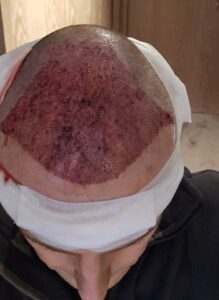
The day of the procedure. My head is scabby and bleeding but there’s no pain
Day 1: Surgery Day 3,400 grafts transplanted over 6 hours. Nervous walking into the operating room but Dr. Soner Tatlıdede and his team were professional and reassuring. The Xanax helped tremendously—I was relaxed throughout. Time passed faster than expected.
Week 2: The Awkward Phase This phase looks rough. Scabs everywhere, donor area shaved, wearing a headband. I stayed home mostly. The donor area was slightly sore for 3 days, then fine. Scabs started falling during gentle washing after day 7. Following hair transplant aftercare instructions carefully was crucial here.
Month 1: Looking Pretty Good (Temporarily) Scabs gone by week 3. The transplanted hair looked decent—I thought I’d gotten lucky and wouldn’t experience shedding. I was wrong.
My head during the shedding phase. I still have pinkness on the scalp and most of the implanted hairs have fallen out.
Month 3: The Shedding Phase This was the hardest phase psychologically. Around week 8-12, the transplanted hair started falling out. By month 3, my head looked thinner than before the hair transplant procedure. I wore a cap whenever I left the house. The clinic’s WhatsApp support during this phase was invaluable—they reassured me this was completely normal.
Month 6: Real Growth Emerging Around month 4, tiny hairs started sprouting from the transplanted follicles. By month 6, hair density had increased significantly. I stopped wearing a cap. People started commenting that my hair looked great (those who didn’t know about the procedure just thought I was using good products).
Month 7 (Current): Natural Results I have what I’d describe as a full head of hair. The transplanted follicles blend perfectly with my native hair. Nobody can tell I’ve had hair implant surgery in Turkey unless I tell them. Friends who knew are impressed. Friends who didn’t know just think my hair looks healthier.
The hair density will continue improving through months 12-18, but I’m already thrilled. I get regular compliments. My confidence is much higher (of course, this is just my experience not guaranteed for everyone!). My only regret is not starting my hair transplant journey 7 years sooner.
What People Actually Said About My New Hair
I worried for years about reactions. Here’s what actually happened:
Friends I told beforehand: 100% supportive. Several said my Turkey hair transplant result looked great and quietly asked where I went because they’re considering it themselves. There’s zero stigma nowadays—everyone’s getting it done!
Friends I didn’t tell: They noticed I looked better but couldn’t identify why. Comments like “Your hair looks really good lately” or “What products are you using?” They genuinely thought it was just healthier natural hair growth.
Family: My confidence boost was obvious to them. They said I seemed happier and more comfortable in photos.
Strangers: Nobody notices anything unusual. The natural results look completely authentic—exactly what I wanted.
The Psychological Shift
The hardest part isn’t the logistics or the hair transplant procedure—it’s overcoming psychological barriers. I delayed 7 years through overthinking. Set a decision deadline: research thoroughly for 2-3 months, then commit.
Turkey has become a global leader in hair restoration because hundreds of thousands have successfully navigated this journey. The question isn’t whether it’s possible to restore their hair—it’s whether you’re ready to start your hair transformation today.
What I still couldn’t know in advance
Despite exhaustive research and choosing a great company, I couldn’t know exactly how dense my results would feel at month 7, how stressful the shedding phase would be, or how long it would take before I stopped thinking about my hair daily. Those unknowns are part of the process — even when the outcome is good.
About This Guide Author: Jonathan, hair transplant patient (not a medical professional) Procedure Date: January 2025 at Clinicana, Istanbul Procedure Type: FUE with 3,400 grafts Current Status: 7 months post-procedure with natural results Last Updated: January 15, 2026
Medical Disclaimer: I am not a doctor or medical professional. This guide shares my personal experience and research. Always consult qualified surgeons and make your own informed decisions about hair restoration procedures.
Transparent Disclosure
I am affiliated with Clinicana now (having experienced their service and achieved excellent results), but:
✗ I was not given a discounted procedure ✗ This is not a sponsored review ✓ I paid the full €2,850 package price like any patient ✓ All opinions are my own based on personal experience
This review reflects my personal hair transplant experience at one facility. While I’m thrilled with my results and would use them again, every patient is different. Research multiple clinics, verify credentials, check turkey reviews across platforms, and select based on YOUR specific needs—not just where I went.
Medical Disclaimer: I am not a doctor or medical professional. This guide shares my personal experience and research. Always consult qualified surgeons and make your own informed decisions about hair restoration procedures. Personal experience does not constitute medical advice.
Related Hair Restoration Procedures
Beard Transplant
Beard transplant procedures use the same FUE or DHI techniques to move scalp follicles to facial areas, creating fuller beards, filling patches, or designing specific beard styles. Turkish clinics charge £1,200-£2,000 for beard transplants depending on graft count (typically 2,000-3,500 grafts). Recovery takes 7-10 days similar to scalp procedures, with full results visible in 12 months.
Celebrity Hair Transformations
Celebrity hair transplants have normalized the procedure. Public figures including Elon Musk, Wayne Rooney, and many actors have openly discussed their hair restoration journeys. This visibility has reduced stigma and encouraged more people to seek effective hair solutions. Many celebrities travel to Turkey for procedures, contributing to Istanbul’s reputation as a global destination for hair transplants.
PRP Therapy for Hair Growth
Some clinics offer PRP (Platelet-Rich Plasma) therapy alongside hair transplant procedures in Turkey. PRP involves drawing your blood, concentrating the platelets, and injecting them into your scalp to potentially stimulate hair growth. While some patients report improved density, PRP’s effectiveness for hair restoration remains debated. Consider it an optional enhancement, not a replacement for proven transplant methods.
Ready to Start Your Hair Transplant Journey?
If you’re weighing concerns about getting a hair transplant or plugs in Turkey, here are practical first steps to start your journey with confidence.
Step 1: Determine If You’re a Good Candidate
Ideal candidates for hair transpants procedures in Turkey have stable hair loss patterns, sufficient donor hair in the back and sides of the head, realistic expectations, and good overall health. If you’re under 25 or experiencing sudden hair loss, consult a dermatologist first to rule out temporary conditions or medical issues.
Step 2: Research and Shortlist Clinics
When researching many hair transplant clinics in Istanbul, use these must-have criteria:
Operates in certified hospital setting
Turkish Ministry of Health licensing with current credentials
Lead surgeon performs the entire procedure (confirm who does extraction and implantation)
500+ verified reviews across multiple platforms
Clear, transparent pricing for hair transplant cost
Step 3: Contact and Evaluate
Reach out to 3-5 leading hair restoration facilities via WhatsApp. Send photos of your hair from multiple angles and ask:
“What hair transplant technique do you recommend and why?”
“How many grafts do I realistically need?”
“What’s included in your package price?”
“Who performs extraction and implantation—the surgeon or technicians?”
Red flags: Guaranteeing graft counts before proper hair analysis, claiming 100% success rates, or pressuring you to book immediately without time to research.
Step 4: Timeline and Preparation
The leading hair transplant facilities book 2-3 months in advance. Once booked:
Stop smoking 2 weeks before your hair transplant surgery
Avoid blood thinners (aspirin, ibuprofen) for 1 week prior
Arrange 7-10 days off work for travel and initial recovery
Pack button-up shirts (easier to wear post-procedure without disturbing grafts)
Manage Expectations Realistically
You will get:
Natural-looking hair that blends with your native hair
Permanent results resistant to male pattern hair loss
Significantly improved confidence and appearance
You won’t get:
Instant results (patience required for 12-18 months full density)
Stopped balding in non-transplanted areas of your scalp
Perfect replication of your teenage hairline (mature hairlines look more natural)
Every person looking to restore their hair has different starting points—work with your hair transplant doctor to define what’s achievable for your specific situation.
About This Guide Author: Jonathan, hair transplant patient (not a medical professional) Procedure Date: January 2025 at Clinicana, Istanbul Procedure Type: FUE with 3,400 grafts Current Status: 7 months post-procedure with natural results Last Updated: January 15, 2026
Medical Disclaimer: I am not a doctor or medical professional. This guide shares my personal experience and research. Always consult qualified surgeons and make your own informed decisions about hair restoration procedures.
Frequently Asked Questions
How much does a hair transplant in Turkey cost?
Prices range from €1,500 to €3,500 depending on technique, number of grafts, and package inclusions. Standard FUE packages average €2,000-€2,500, while premium techniques like DHI cost €3,000-€4,000. My experience: I paid €2,850 for FUE with 3,400 grafts. Adding flights (€350) and meals (€100), my total real cost was €3,300—still 60% less than the cheapest UK option I’d found at £5,500.
How many grafts do I need?
This varies based on your hair loss pattern and desired density. Most procedures use 2,500-4,500 grafts. Your surgeon calculates the exact number during consultation based on your donor area and recipient site size.
Is it safe to get a Turkish Hair Transplant?
Yes, when choosing accredited clinics with qualified surgeons. Look for facilities licensed by the Turkish Ministry of Health, operating in certified medical environments, with experienced doctors leading procedures.
My experience: Safety was my top priority after 7 years of worrying. I chose a hospital-based facility with full accreditation. The operating room was hospital-grade with modern sterilization equipment. I experienced zero complications. (All surgical procedures carry risks, even when performed in accredited facilities.)
What's better: FUE or DHI?
Both produce excellent results. FUE is more common, proven, and typically less expensive. DHI offers more precise control and potentially higher graft survival but costs more. Your surgeon should recommend the technique suited to your needs.
My experience: My surgeon recommended FUE because I needed 3,800 grafts. DHI would have been unnecessarily expensive for that volume. I’m thrilled with FUE results—the technique matters less than surgeon skill.
How long does recovery take?
Most people return to work after 7-10 days. Scabs fall away within 2 weeks. You can resume normal activities after 10-14 days, though transplanted hairs will shed before regrowing starting around month 3.
Can women get hair transplants in Turkey?
Absolutely. Women experiencing pattern hair loss, thinning, or traction alopecia often benefit from transplants. The procedure and recovery process are the same as for men.
Context: Turkish clinics told me 20-30% of their patients are women. The technique focuses on filling in thinning areas rather than rebuilding entire hairlines like men typically need.
What's included in a hair transplant package?
Standard packages include surgery, consultations, hotel accommodation, airport and clinic transfers, medications, aftercare products, and post-op support. Premium packages may add upgraded hotels, meals, or PRP therapy.
My experience: My €2,850 package included absolutely everything: FUE surgery, detailed consultation, 4 nights at 4-star hotel with breakfast, all transfers, English-speaking coordinator, medications, complete aftercare kit, post-op wash, and year-long WhatsApp support. Only flights and evening meals were separate.
Is it safe to travel alone to Turkey?
Yes. Clinics cater extensively to solo international patients, providing English-speaking coordinators, organized transfers, and constant support. Many patients travel alone without issues.
My experience: After delaying 7 years, traveling to Istanbul was one of the best decisions I made. The process was easier than expected—4-hour flight, organized transfers, English-speaking staff. I saved approximately €6,500 versus UK costs while receiving exceptional care.
Can hair thinning return after a transplant?
Transplanted hair is permanent because follicles are taken from areas genetically resistant to hair loss. However, existing hair not transplanted may continue thinning over time due to ongoing male pattern baldness.
When will I see results?
Initial growth begins around month 3-4, with noticeable improvement by month 6. Full results typically appear between months 12-18 as transplanted hair reaches maximum density and maturity.
My experience: Month 3 was hard (shedding phase). Month 4-5 saw tiny hairs sprouting. Month 6 brought noticeable improvement. At month 7 (current), I have natural-looking results that keep improving weekly.
Does a hair transplant hurt?
No. Local anesthesia numbs your scalp—you feel initial injection discomfort for about 10 seconds, then no pain during the 6-8 hour procedure.
My experience: The anesthesia stung briefly going in (like a bee sting for 30 seconds), then I felt no pain during the 6-hour surgery. The donor area felt like mild sunburn the first night—I took paracetamol and slept fine. By day 3, zero pain.
How long do hair transplant results last?
Transplanted hair is permanent. Follicles from your donor area are genetically resistant to DHT (the hormone causing male pattern baldness), so they continue growing for life.
My experience: At 7 months, my transplanted hair is growing strong. My surgeon explained these follicles will keep producing hair permanently because they came from the back of my scalp—an area resistant to balding.
How do I choose the best hair transplant clinic in Turkey?
It can be hard to find the best clinic in Turkey. Doing your research is key.
My experience: I created a checklist: (1) operates in certified hospital, (2) surgeon has 5,000+ procedures, (3) reviews on Google and Trustpilot, (4) before/after photos with similar hair loss, (5) responsive WhatsApp communication, (6) clear package inclusions, (7) satisfaction guarantee. I eliminated cheap options (under €1,500) and non-hospital facilities.
This guide represents 6 months of research, 7 years of hesitation overcome, and 7 months of documented results. I hope it gives you the knowledge and confidence I wish I’d had to get it done sooner. You deserve to have great hair and the confidence that comes with it.




 Continue with Google