

Author: Jonathan | Procedure Date: January 2025 | Last Updated: January 2026
I document real hair transplant experiences on Hair Transplant Turkey Guide. I underwent a 3,400-graft FUE hair transplant at Clinicana Hair Transplant & Esthetic Surgeries in Istanbul. This review documents my complete experience from consultation through 7 months of results.

Clinicana Hair Transplant & Esthetic Surgeries Review Summary
Clinicana is a legitimate hair transplant clinic operating inside Acıbadem Taksim Hospital in Istanbul. The clinic suits international patients seeking a hospital-based procedure with all-inclusive packages at competitive pricing. My FUE procedure cost €2,850 and delivered natural results at 7 months.
Is Clinicana a Scam or a Legit Clinic?
Clinicana is a licensed hair transplant clinic operating inside Acıbadem Taksim Hospital in Istanbul. It is not a scam.
The “Clinicana scam” searches exist because hair transplant patients naturally research clinic legitimacy before committing to medical tourism. Turkey has over 500 hair transplant clinics, and not all maintain equal standards. This creates understandable caution among prospective patients.
Clinicana operates within the regulatory framework of the Turkish Ministry of Health. The clinic holds ISO 9001 certification and performs procedures inside a JCI-accredited hospital facility. These credentials distinguish it from unregulated “basement clinics” that give Turkish medical tourism a poor reputation.
Common misunderstandings that fuel “scam” searches include:
- Technician involvement: Like most Turkish clinics, Clinicana uses trained technicians for extraction and implantation under surgeon supervision. This is standard practice, not deception.
- Results timeline: Final results take 12–18 months. Patients expecting immediate density may feel disappointed at 3–6 months during the shedding phase.
- Package pricing: The fixed-price model (up to 5,000 grafts) differs from per-graft pricing common elsewhere. This is a pricing structure, not a scam.
My experience: The clinic delivered exactly what they promised. No hidden fees. Professional treatment. Natural-looking results at 7 months with continued improvement expected.
Who Owns Clinicana?
Clinicana Hair Transplant & Esthetic Surgeries operates as a clinic brand within Acıbadem Taksim Hospital. The hospital is part of Acıbadem Healthcare Group, one of Turkey’s largest private healthcare networks.
Acıbadem Healthcare Group operates 22 hospitals and 16 outpatient clinics across Turkey. The group holds Joint Commission International (JCI) accreditation—the gold standard for international healthcare quality. This accreditation requires meeting rigorous patient safety and care standards reviewed every three years.
This ownership structure matters for several reasons:
- Medical oversight: Procedures occur within a fully equipped hospital, not a standalone cosmetic clinic
- Emergency protocols: Hospital-grade emergency facilities are immediately accessible
- Regulatory compliance: The hospital operates under Turkish Ministry of Health licensing requirements
- Quality standards: JCI and ISO 9001 certification require documented protocols and regular audits
Understanding who owns Clinicana helps distinguish it from independent clinics operating in commercial buildings without hospital affiliation.
Where Is Clinicana Located?
Clinicana operates inside Acıbadem Taksim Hospital in the Beyoğlu district of Istanbul. The hospital address is Sıraselviler Caddesi No: 119, 34433 Beyoğlu/Istanbul.
The hospital environment provides several advantages over standalone “hair mill” clinics:
- Medical infrastructure: Operating rooms meet hospital-grade sterilization standards
- Emergency access: Full hospital facilities available if complications occur
- Regulatory oversight: Hospital operations face stricter government inspection than independent clinics
- Professional environment: Staff work within a broader healthcare institution, not a high-volume cosmetic factory
The clinic’s hotel (Naz City Hotel Taksim) sits approximately 150 meters from the hospital. A free shuttle operates between the hotel and clinic, though walking takes only 2–3 minutes. This proximity made post-procedure care convenient—I returned to my room within minutes of completing the first wash.
The Taksim area is central, safe, and well-connected to Istanbul’s public transport. International patients have easy access to restaurants, pharmacies, and the airport.
Who Performs the Hair Transplant Surgery at Clinicana?
This section addresses the most important question prospective patients ask: who actually performs the procedure?
The surgical team structure:
- Lead Surgeon: Dr. Soner Tatlıdede serves as Chief Plastic Surgeon. He designed my hairline, performed the initial consultation, and supervised the procedure.
- Trained Technicians: A team of technicians performs graft extraction and implantation under surgeon supervision. This is standard practice in Turkish high-volume clinics.
- Anesthesiologist: A qualified anesthesiologist administered local anesthesia and monitored my condition throughout the 6-hour procedure.
- Patient Coordinator: Chinara Farzalieva coordinated my entire journey from initial consultation through post-procedure follow-up.
What the surgeon does:
- Initial consultation and scalp assessment
- Hairline design (this is critical—my surgeon spent 20 minutes designing the hairline following my forehead muscles for natural appearance)
- Graft count determination
- Procedure supervision
- Quality control of placement density and angle
What technicians do:
- Follicular unit extraction from the donor area
- Graft preparation and storage
- Channel creation (in some cases)
- Graft implantation into recipient channels
This division of labor is how Turkish clinics achieve competitive pricing while maintaining high procedure volumes. Patients expecting the surgeon to perform every extraction and implant personally will be disappointed—but this expectation is unrealistic for any high-volume clinic globally.
The critical factor is surgeon involvement in hairline design and overall supervision. My hairline looks natural because an experienced surgeon designed it. The technicians executed that design skillfully under his oversight.
What Hair Transplant Methods Does Clinicana Use?
Clinicana offers multiple hair transplant techniques. Understanding these methods helps you discuss options during your consultation.
FUE (Follicular Unit Extraction)
FUE is the most established modern hair transplant technique. Individual hair follicles are extracted from the donor area (back and sides of the head) using micro-punch tools (0.7–0.9mm diameter). These follicular units are then implanted into the recipient area (balding or thinning zones).
I chose FUE for my procedure. Key characteristics:
- Minimal scarring (small dot scars in donor area)
- 85–95% graft survival rate when performed correctly
- Suitable for large graft counts (2,500+ grafts)
- Recovery time: 7–10 days for visible healing
FUE costs less than DHI and works well for patients needing extensive coverage. My surgeon recommended FUE because my Norwood 3 pattern required 3,400 grafts—DHI would have been unnecessarily expensive.
DHI (Direct Hair Implantation)
DHI uses a specialized Choi implanter pen that creates the recipient channel and places the graft simultaneously. This differs from FUE’s two-step process (create channel, then insert graft).
DHI advantages:
- Higher precision placement for smaller areas
- Potentially faster healing
- No shaving required in some cases (preferred by some women)
DHI limitations:
- Higher cost than FUE
- Not cost-effective for large graft counts (4,000+)
- Limited benefit for extensive baldness patterns
Sapphire FUE
Sapphire FUE is a refined version of standard FUE using sapphire-tipped blades instead of steel to create recipient channels. The harder, sharper blades maintain sharpness longer and produce more uniform incisions.
Clinicana offers Sapphire FUE, but my surgeon advised it makes only marginal difference. His perspective: surgeon skill matters far more than blade material. The price difference (included in Premium packages) may not justify the claimed benefits for most patients.
When Each Method Is Used
- FUE: Large areas, high graft counts, budget-conscious patients
- DHI: Smaller areas, crown work, patients wanting no shaving
- Sapphire FUE: Patients wanting slightly higher density potential, willing to pay premium
Your surgeon should recommend based on your specific hair loss pattern, donor density, and budget—not upsell premium methods unnecessarily.
My Hair Transplant Procedure Step by Step
Here is exactly what happened during my January 2025 procedure at Clinicana.
Day Before: Arrival
- Driver met me at Istanbul Airport with a name sign
- Quick stop at the clinic for blood tests and initial deposit (€300)
- Transfer to Naz City Hotel Taksim
- Received WhatsApp confirmation of 8:00am procedure time next day
Procedure Day: Morning Consultation (8:00–9:00am)
- Met Dr. Soner Tatlıdede for final consultation
- Surgeon examined my scalp and confirmed 3,400 graft count
- Hairline design took approximately 20 minutes—surgeon followed my forehead muscles for natural appearance
- Donor area shaved and extraction zones marked
- Final questions answered (I asked about graft survival rates and whether I would need a second procedure)
Anesthesia (9:00–9:30am)
- Local anesthesia injections administered
- Initial injections stung for approximately 30 seconds (comparable to bee sting)
- Scalp went completely numb afterward
- Offered Xanax—I accepted and highly recommend this. It kept me relaxed throughout.
Extraction Phase (9:30am–12:30pm)
- Lay face-down while technicians extracted individual follicular units from donor area
- Listened to podcasts during this phase
- Completely painless after anesthesia took effect
- 3,400 follicular units extracted over approximately 3 hours
Lunch Break (12:30–1:00pm)
- Clinic provided sandwich and fruit
- Food was basic but adequate (most patients are too nervous to eat much anyway)
Implantation Phase (1:00–4:30pm)
- Lay face-up while surgeon created channels and team placed each graft
- Grafts placed to match natural hair growth patterns
- Listened to music playlist during this phase
- Still completely painless
- I watched the surgeon work in a mirror during channel creation—professional and meticulous
Post-Procedure (4:30–5:00pm)
- Head bandaged
- Received medications and aftercare instructions
- Reviewed what to expect during recovery
- Walked back to hotel (150 meters)
- Donor area felt like mild sunburn—took paracetamol and felt fine
Total procedure duration: Approximately 6 hours including breaks.
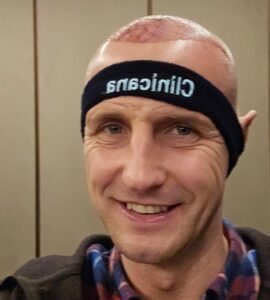
My Graft Count, Hairline & Density
Classification: Norwood Scale 3 (receding hairline with temple recession)
Graft count: 3,400 follicular units transplanted
Age at procedure: 43 years old
Areas treated: Frontal hairline and temples
Hairline Design
Dr. Tatlıdede designed my hairline following the natural contours of my forehead muscles. This is critical—a hairline placed below the forehead muscles looks unnatural and obvious.
He explained that many patients request very low, aggressive hairlines. Experienced surgeons refuse these requests because:
- Low hairlines look unnatural as patients age
- Future hair loss behind the transplanted area creates an “island” effect
- Insufficient donor hair exists to maintain ultra-low hairlines long-term
My hairline is age-appropriate, follows my natural muscle line, and allows for potential future procedures if native hair loss continues.
Density Expectations
3,400 grafts covering a Norwood 3 pattern achieves good but not maximum density. Realistic expectations:
- Natural appearance when styled normally
- Visible scalp may remain under direct harsh lighting
- Hair can be styled with volume and texture
- Not “thick as a teenager” but dramatically improved from pre-transplant appearance
Patients wanting extremely dense results may require a second procedure 12–18 months later. My surgeon discussed this possibility during consultation—honest communication I appreciated.
Clinicana Hair Transplant Results Timeline
Hair transplant results develop gradually over 12–18 months. Here is my documented timeline:
Day 1
Procedure completed. Scalp swollen and tender. Donor area resembled mild sunburn. Recipient area covered with freshly implanted grafts visible as small dots. Wore protective headband. Took paracetamol for minor donor area discomfort.
Day 2–3
First scalp wash at clinic. Medical technician demonstrated gentle washing technique for the next 2 weeks. Received headband to prevent swelling. Swelling developed after removing headband—ice resolved it quickly.
Week 1–2
Scabbing covered the recipient area. Followed washing instructions carefully. Donor area redness fading. Slight soreness felt like sunburn—used cream recommended by clinic. Stayed home during this phase.
Week 2–4
Scabs fell off during gentle washing after day 7. By week 3, scabs were completely gone. Transplanted hair looked decent at this point—I hoped I would avoid the shedding phase. I was wrong.
Month 2–3: Shock Loss Phase
Shock loss is a medically expected phase where transplanted hair shafts fall out before new growth begins. The follicles remain healthy beneath the scalp—only the visible hair sheds.
My shock loss was significant. By month 3, my head looked thinner than before the procedure. This phase was psychologically difficult despite knowing it was normal. I wore a cap whenever leaving the house.
I messaged Clinicana’s WhatsApp support in a panic. They responded within hours: “This is completely normal. 90% of patients experience shock loss. Your follicles are healthy—only the visible hairs shed before regrowth.”

Month 4–5
Tiny hairs started sprouting from transplanted follicles. Growth appeared thin initially. Scalp fully healed. Continued wearing cap in public. Patience required during this phase.
Month 6
Hair density increased noticeably. Stopped wearing cap. Started receiving compliments about my hair from people who did not know about the procedure. They assumed I was using good hair products.
Month 7 (Current)
My new hairline is clearly visible, natural-looking, and continuing to improve. Hair can be styled normally. The hairline design looks age-appropriate and follows natural growth patterns.

Month 12–18 (Expected)
Full results typically mature between 12–18 months. Hair density will continue improving. Some patients see additional thickening through month 18.
Clinicana Cost Breakdown
Clinicana uses fixed-price packages rather than per-graft pricing. This model covers up to 5,000 grafts at the same price—beneficial for patients needing higher graft counts.
Package Pricing (2025)
| Package | Price (EUR) | Hotel Nights | Notable Inclusions |
|---|---|---|---|
| Basic | €2,500 | 2 nights | Standard inclusions |
| Standard | €2,850 | 2 nights | Most popular option |
| Premium | €3,000 | 3 nights | Upgraded products, extra hotel night |
What Is Included
- All consultations (pre-procedure and post-procedure)
- FUE/DHI/Sapphire procedure (up to 5,000 grafts)
- Hotel accommodation (varies by package)
- VIP airport transfers (arrival and departure)
- Hotel-clinic transfers
- Blood tests
- Medications
- Aftercare products (shampoo, lotion, spray)
- English-speaking translator/coordinator
- First scalp wash at clinic
- Follow-up support via WhatsApp
- Growth guarantee (request written terms before booking)
What Is Not Included
- Flights (I paid approximately £295 from UK)
- Evening meals (hotel breakfast included, dinner is not)
- Optional serums/supplements (I purchased Clinicana Serum for €90)
- Travel insurance
My Total Cost
| Item | Cost |
|---|---|
| Standard Package | €2,850 (~£2,400) |
| Flights (UK return) | £295 |
| Evening meals (3 nights) | ~£85 |
| Clinicana Serum (optional) | ~£75 |
| Total | ~£2,855 |
Comparison: The cheapest UK hair transplant quote I received was £8,000. Clinicana’s all-inclusive package cost 64% less.
Why Prices Vary
Turkish hair transplant pricing varies based on:
- Clinic reputation and volume: Established clinics charge more than newer operators
- Hospital vs. standalone clinic: Hospital-based procedures cost more due to facility fees
- Surgeon involvement level: Higher surgeon involvement increases costs
- Technique: DHI and Sapphire FUE cost more than standard FUE
- Package inclusions: Premium packages include upgraded products and services
Clinicana’s pricing sits in the mid-range for hospital-based Istanbul clinics. Very cheap options (under €1,500) often indicate less experienced staff, lower-quality facilities, or compromised hygiene standards.
Pros and Cons of Clinicana
Pros
- Hospital setting: Procedures performed inside JCI-accredited Acıbadem Hospital, not a standalone clinic
- Medical oversight: Full hospital facilities available if complications occur
- All-inclusive pricing: No hidden fees; clear package structure up to 5,000 grafts
- Professional coordination: English-speaking staff, WhatsApp communication, smooth logistics
- Convenient location: Hotel 150 meters from clinic in central Istanbul
- Natural results: Experienced hairline design; my results at 7 months look authentic
- Post-procedure support: Responsive WhatsApp follow-up at 1, 3, and 6 months
- Transparent process: Clear explanation of what to expect at each stage
Cons
- Technician-performed extraction/implantation: Surgeon supervises but does not personally perform all steps; differs from boutique clinics offering surgeon-only procedures
- High patient volume: The clinic operates at high weekly patient volume; less personalized than low-volume practices
- Limited surgeon face time: After hairline design, surgeon involvement is supervisory; technicians perform most hands-on work
- Basic lunch: Procedure-day food was adequate but not impressive
- Airport transfer experience: Functional but not luxurious
- Shock loss not emphasized enough: I wish the psychological difficulty of month 2–3 shedding was explained more thoroughly beforehand
Common Complaints and Negative Clinicana Reviews Explained
Negative reviews exist for Clinicana, as they do for any high-volume clinic. Understanding common complaints helps set realistic expectations.
Density Complaints
Complaint: “My hair isn’t as thick as I expected.”
Medical explanation: Hair transplants redistribute existing hair follicles—they do not create new follicles. Patients with limited donor hair cannot achieve unlimited density. Additionally, some patients assess results too early; full density develops over 12–18 months.
My perspective: My 3,400 grafts provide good coverage for a Norwood 3 pattern. It is not teenager-thick hair, but it is a dramatic improvement. Patients expecting maximum density may need a second procedure or should choose a clinic specializing in high-density work at higher cost.
Unrealistic Expectations
Complaint: “I wanted my hairline lower.”
Medical explanation: Ethical surgeons refuse inappropriately low hairlines because they look unnatural as patients age and cannot be sustained long-term due to ongoing native hair loss. Clinicana’s surgeons design age-appropriate hairlines—this disappoints patients seeking aggressive restoration.
Communication Issues
Complaint: “Communication could be better.”
Context: High-volume clinics manage hundreds of patients monthly. Response times may be slower than boutique clinics with lower patient loads. My experience: WhatsApp responses typically arrived within 24 hours, which I found acceptable but not instant.
Technician Involvement
Complaint: “Technicians did most of the work, not the surgeon.”
Industry context: This is standard practice in Turkish hair transplant clinics. The surgeon designs the hairline, determines graft count, supervises the procedure, and ensures quality. Technicians perform extraction and implantation under supervision. Patients wanting surgeon-only procedures should seek boutique clinics at significantly higher cost.
I do not dismiss these complaints. They reflect real experiences. However, most complaints stem from expectation mismatches rather than clinical failures. Informed patients who understand the technician model, realistic density limits, and extended results timeline report satisfaction.
Who Should Choose Clinicana?
Clinicana suits patients who:
- Want a hospital-based procedure with JCI-accredited facilities and medical oversight
- Value all-inclusive pricing without hidden fees or per-graft calculations
- Need moderate to high graft counts (2,000–5,000 grafts) where FUE offers cost efficiency
- Accept the technician model where surgeons supervise but do not personally perform every extraction and implant
- Prioritize value over exclusivity—Clinicana offers professional results without boutique pricing
- Are comfortable with medical tourism logistics including international travel and recovery away from home
- Have realistic expectations about results timeline (12–18 months for full density)
Who Should Avoid Clinicana?
Clinicana may not suit patients who:
- Want surgeon-only procedures where the doctor personally performs all extraction and implantation
- Prioritize extremely low patient volumes and highly personalized attention
- Have very advanced hair loss (Norwood 6–7) requiring complex multi-session planning with specialized expertise
- Require complicated revision work from previous failed procedures
- Cannot tolerate medical tourism stress including travel, language barriers, and recovering abroad
- Have unrealistic density expectations that cannot be achieved with available donor hair
- Prefer local aftercare access with in-person follow-up appointments
Patients in these categories should consider boutique clinics with lower volumes and higher surgeon involvement, even at increased cost.
Clinicana vs Other Hair Transplant Clinics in Turkey
Comparing Turkish hair transplant clinics requires understanding key differentiating factors.
| Factor | Clinicana | High-Volume Competitors | Boutique Clinics |
|---|---|---|---|
| Setting | Hospital-based (Acıbadem) | Often standalone clinics | Private surgical suites |
| Surgeon Involvement | Design + supervision | Varies widely | Often surgeon-performed |
| Patient Volume | High volume | 100+ per week | 5–15 per week |
| Price Range | €2,500–€3,000 | €1,500–€2,500 | €4,000–€10,000+ |
| Accreditation | JCI, ISO 9001 | Varies | Often private certification |
Key Differentiators
Hospital vs. Standalone: Clinicana’s hospital setting provides emergency access and regulatory oversight that standalone clinics lack. This matters more for risk-averse patients than for those prioritizing luxury.
Volume Considerations: High volume means experienced technicians who have performed thousands of procedures. It also means less personalized attention. Neither is inherently better—it depends on patient priorities.
Pricing Reality: Clinicana’s mid-range pricing reflects its hospital overhead and professional standards. Very cheap options often cut corners on hygiene, equipment, or staff training. Premium options provide surgeon-only procedures and lower volumes.
I chose Clinicana because the hospital setting and track record justified mid-range pricing without requiring boutique costs. My results validate that decision.

 Continue with Google