

I’ve seen countless patients make the same mistake: they obsess over whether FUE or FUT is “better” without considering their hair type first. Here’s what you need to know—the technique that works beautifully for your best friend’s straight hair might actually undermine your curl pattern. Your hair type doesn’t just influence results; it fundamentally changes how your surgeon should approach the entire procedure. So what’s the right choice for you?
Why Hair Type Matters More Than You Think
When you’re researching hair transplant techniques, you’ll notice clinics and surgeons emphasize different methods—FUE, DHI, FUT, and newer variations. What they often don’t explain is why your hair type should shape that choice.
Your hair’s natural characteristics—thickness, curl pattern, density—directly affect how grafts survive, grow, and ultimately look. Curly hair behaves differently under the skin than straight hair. Fine hair requires a different targeted transplant strategy than coarse hair.
Without matching technique to your hair type, you risk poor graft placement, unnatural angles, or suboptimal graft distribution. A method that works brilliantly for one person can underperform for another.
This isn’t marketing. It’s anatomy. Understanding this difference separates realistic expectations from disappointment.
How Straight Hair Responds to FUE and FUT
Because straight hair grows at a consistent angle and lies flat against the scalp, it’s technically one of the more forgiving hair types to transplant—but that doesn’t mean all techniques handle it equally.
Both FUE and FUT work well with straight hair, but they differ in execution:
- Grafting angle — FUE allows precise directional control, critical for matching your natural growth pattern; FUT requires the surgeon’s skill during individual graft placement.
- Graft distribution — Straight hair’s uniform growth makes dense packing easier, reducing visible gaps.
- Visibility — Any minor angulation errors show more obviously than with curly hair, which masks imperfections naturally.
- Scarring impact — FUT’s linear scar is more noticeable if your straight hair recedes further; FUE avoids this risk.
The technique matters less than the surgeon’s precision with your specific hair characteristics.
Transplanting Curly Hair: Technique Adjustments and Expectations
Curly hair presents a fundamentally different surgical problem than straight hair, and it demands specific technical adjustments that many surgeons don’t fully master.
The core challenge: curly hair‘s natural curl pattern density makes extraction trickier. Grafts must be harvested at precise angles to preserve the follicle’s natural curve. If angled incorrectly, you’ll lose the curl entirely—leaving transplanted hair visibly straighter than your native hair.
Post-surgical curl uniformity is equally critical. Your surgeon needs to:
- Extract grafts respecting the hair’s directional spiral
- Implant at angles matching your scalp’s existing curl pattern
- Account for how curls naturally spread and contract
This requires surgeon experience with textured hair specifically. During my research into clinics, I prioritized surgeons with documented success transplanting curly and textured hair types. It’s a legitimate technical difference, not a marketing angle.
Fine or Thin Hair: Which Technique Minimizes Shock Loss?
Fine or thin hair changes the transplant equation entirely—not because the technique fundamentally differs, but because the margin for error shrinks.
When your native hair lacks density, every extracted graft matters. Shock loss—temporary shedding after surgery—affects thin hair more visibly because you’re working with less coverage to begin with.
Both FUE and FUT can work, but precision becomes critical:
- FUE minimizes scarring and suits those concerned about visible donor-site marks
- Lower graft counts preserve donor density and prevent over-harvesting
- Careful angle placement maintains volume and natural appearance
- Staged procedures spread trauma, reducing shock loss impact
The real question isn’t which technique, but whether your surgeon respects the limits of thin hair. Aggressive extraction or unrealistic graft numbers create visible gaps. Conservative planning—maintaining your existing density—matters more than chasing maximum coverage.
Coarse or Thick Hair: Maximizing Density and Natural Appearance
If you’ve got thick or coarse hair, you’re working from a position of strength—but that advantage can be squandered if your surgeon doesn’t adapt their approach.
Your hair’s density means you can achieve fuller results with fewer grafts. However, procedure adaptations are critical. Surgeons need to space grafts strategically to avoid overcrowding, which creates an unnatural appearance despite high graft density.
Surgical considerations include angle and depth. Coarse hair requires precise implantation angles to match your natural growth pattern—even slight misalignment becomes visible. Your surgeon should also account for hair’s natural volume; less aggressive density distribution often looks better than maximum saturation.
The goal isn’t packing in every graft possible. It’s using your hair’s thickness to create undetectable, proportional coverage. That restraint separates excellent results from overdone ones.
Crown Baldness: Why Placement Technique Changes Everything
The crown presents a unique challenge because you’re working with visible hair that grows in multiple directions—and a surgeon’s graft placement directly affects whether new hair blends seamlessly or looks obviously transplanted.
I learned this matters enormously when I watched my surgeon discuss crown angles during my consultation; even a few degrees off can mean the difference between natural coverage and a noticeable scar or misaligned growth pattern.
That’s why density, graft angle, and directional blending aren’t separate concerns for crown work—they’re interdependent, and getting all three right is what actually determines whether the result looks convincing.
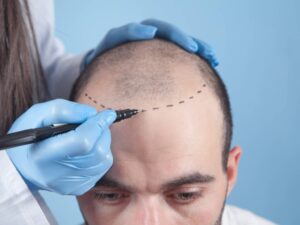
Density Matters For Coverage
While hair loss on the crown creates unique challenges that differ fundamentally from frontal recession, many people don’t realise how much the placement technique itself determines whether you’ll achieve genuine coverage or just a cosmetic Band-Aid.
Crown density requires strategic thinking.
- Graft visibility declines when density reaches 40+ grafts per square centimetre in the crown zone
- Directional placement mimics your natural hair’s growth pattern, disguising transplanted hair among existing strands
- Density control prevents over-harvesting from donor areas, which compromises long-term scalp appearance
- Layering techniques create depth perception, making thinner hair appear fuller without requiring excessive graft numbers
I learned this firsthand during my January 2025 procedure—my surgeon deliberately spaced grafts strategically rather than maximizing count, resulting in natural-looking coverage that doesn’t appear “pluggy” or artificially dense.
Graft Angle And Direction
Because your natural hair grows at a specific angle and direction, transplanted grafts must be placed to match—otherwise they’ll stick out visually, even if the density is perfect.
This is where graft angulation and graft orientation become critical. Your surgeon isn’t just counting hairs; they’re replicating the exact trajectory each follicle takes as it exits your scalp.
| Hair Type | Natural Angle | Placement Challenge |
|---|---|---|
| Straight | 45° forward | Easier to standardize |
| Curly | Variable (60°+) | Requires surgeon precision |
| Crown | Multi-directional | Most technically demanding |
On the crown especially, hair radiates outward in different directions. Grafts placed at the wrong angle look unnatural—they won’t blend with existing hair, creating a patchy or “pluggy” appearance.
The best surgeons spend considerable time during consultation mapping your hair’s natural growth pattern before transplant day. This detail separates natural-looking results from obvious ones.
Blending With Existing Hair
Getting grafts to blend seamlessly with your existing hair isn’t about density alone—it’s about surgical strategy.
The surgeon must consider:
- Junctional zones — grafts placed in layers from front to back create natural density progression rather than harsh edges
- Hair direction alignment — transplanted follicles angled to match your existing hair’s growth pattern prevents visible discordance
- Graft size variation — mixing single-hair grafts with multi-hair units in strategic areas maintains cosmetic uniformity across the scalp
- Surrounding hair density — placing grafts where your remaining hair’s thickness already exists masks the junction zone
When I’d my procedure, the surgeon spent considerable time mapping where my existing hairline met areas needing coverage. This planning phase directly affected seamless integration. Without it, you risk a visible demarcation line—where transplanted hair looks distinctly “added” rather than naturally restored.
Technique matters more than graft count.
Mixed Hair Textures: Planning a Multi-Zone Approach
When you’re dealing with naturally mixed hair textures—say, straight hair on your crown and wavy hair on your sides—your surgeon needs to assess density and growth patterns across each zone separately, not treat your scalp as one uniform canvas. This matters because transplanting fine, straight donor hair into an area where your native hair is thick and curly will create an obvious visual mismatch, even if the graft count looks good on paper.
The best approach matches your donor characteristics to the specific texture and density of each recipient zone, so your result looks naturally consistent across your entire head.
Assessing Density Across Zones
Your scalp doesn’t have uniform hair density—and that’s precisely what makes zone-by-zone assessment critical before a transplant.
During consultation, your surgeon should map density variation across distinct zones: frontal hairline, temporal regions, crown, and mid-scalp. This isn’t theoretical—it directly shapes how many grafts you’ll need and where donor hair quality matters most.
Here’s what assessment reveals:
- Frontal zone requires higher density and finer grafts for natural appearance
- Crown area tolerates slightly lower density due to viewing angle and hair fall patterns
- Temporal regions need density that matches your native hair to avoid visible edges
- Donor site capacity must align with recipient demand across all zones
Without this granular mapping, you risk under-grafting visible areas or over-extracting from limited donor supply. Assessment determines whether your donor hair quality can realistically meet recipient needs across your entire scalp.
Donor Matching for Consistency
Once your surgeon has mapped density needs across zones, the next layer of planning addresses a harder problem: consistency.
You don’t want transplanted hair behaving differently across your scalp. Patient-specific donor matching guarantees grafts from your donor area—typically the back and sides—align with the texture, curl pattern, and growth characteristics of each recipient zone.
If you’re working with mixed hair textures, your surgeon needs to source straighter grafts for frontal areas where curl would look unnatural, while selecting curlier grafts for crown zones where they blend seamlessly. This isn’t guesswork; it’s deliberate selection based on consistent hair growth patterns across your existing hair.
The more precisely your surgeon matches donor characteristics to recipient needs, the more unified your final result appears—even across visibly different zones.
How Surgeon Experience Matters More Than Technique Choice
Because most discussions about hair transplants focus heavily on whether FUE or FUT is “better,” people often miss what actually determines the final result: the surgeon’s skill and judgment.
The technique itself matters far less than how it’s applied. A skilled surgeon excels at surgical technique customization—adjusting angles, depth, and density based on your hair type, scalp laxity, and aesthetic goals. That’s surgeon adaptability in action.
What separates good outcomes from mediocre ones:
- Graft extraction quality—minimizing transection regardless of method
- Recipient site creation—precise angle and depth for natural growth
- Placement strategy—density distribution matching your hair type
- Problem-solving—adjusting mid-procedure when conditions require it
I’ve seen FUE results that look unnatural and FUT results that look seamless. The difference? Experience. A 15-year veteran surgeon will outperform a technically competent but less experienced practitioner, regardless of which technique they choose.
Realistic Outcomes by Hair Type: What the Data Actually Shows
Most hair transplant discussions treat all hair types as interchangeable, which they absolutely aren’t.
The reality is stark: your hair’s structure, density, and texture directly influence transplant eligibility, healing speed, and final density appearance. Individual variability across hair types means what works brilliantly for one person may deliver different results for another.
| Hair Type | Healing Pattern | Density Perception |
|---|---|---|
| Straight | Faster, linear growth | Higher apparent density |
| Curly | Slower initial phase | Lower apparent density, fuller feel |
| Coily | Extended timeline | Requires higher graft count |
Data shows curly-haired patients often need 15–20% more grafts to match straight-haired results visually. Coily textures present the steepest challenge: slower vascularization, longer dormancy periods, and greater shock loss variability.
The takeaway? Your hair type isn’t a barrier—it’s a variable that changes the equation. Honest surgeons account for this during planning.
Asking the Right Questions Before Committing to a Technique
Before you commit to FUE, DHI, or any technique, you need to know whether your surgeon has genuine expertise with *your specific* hair type—not just a general track record. I learned this matters enormously: the technique itself is only half the equation; the surgeon’s experience with fine hair, curly hair, or dense donor zones determines whether you’ll actually see the results you’re promised.
The questions you ask now directly shape the outcome you’ll get.
Understanding Your Surgeon’s Expertise
How do you know if a surgeon actually has the skill to deliver the technique they’re recommending?
This matters more than the technique itself. Experience with your specific hair type—texture, density, growth pattern—directly impacts whether you’ll get a natural hairline design and seamless integration.
Look for:
- Before-and-after portfolio specific to your hair type, not generic results
- Years performing that technique, not just years in hair transplants generally
- Patient reviews mentioning your exact concern—curly hair, crown work, or fine texture
- Willingness to explain why that technique suits you, with specific reasoning
Ask directly: “How many procedures have you done on hair like mine?” A confident surgeon gives a number. Vagueness is a red flag. Your technique choice only works if your surgeon has genuinely mastered it on people with your hair.
Clarifying Expected Outcomes First
Before committing to a technique, ask your surgeon directly: What density can you achieve? How many grafts will you realistically need? What’s the timeline for visible results? What happens if you need a second procedure?
Expected outcomes vary dramatically based on your hair type, scalp laxity, and donor supply. Curly hair, for instance, often requires fewer grafts to appear dense—but a surgeon unfamiliar with curly hair texture might underestimate this and overpromise.
Results clarity matters more than technique choice. A skilled surgeon delivering honest expectations beats any “advanced” method paired with vague promises. Push for specifics, not reassurances.
Frequently Asked Questions
Will My Transplanted Hair Texture Change or Become Different From My Natural Hair Over Time?
No, your transplanted hair retains its original texture. I learned that follicular growth maintains the characteristics of where the hair came from—your donor area. Your new hair won’t change texture; it grows exactly as your natural hair does.
Can I Switch Techniques Mid-Procedure if My Surgeon Identifies Unexpected Scalp or Hair Characteristics?
Yes, your surgeon can adjust techniques during your procedure if they discover unexpected scalp characteristics. I’d recommend discussing this flexibility during your surgeon consultation—it’s a sign they’re prioritizing your specific needs, not just executing a preset plan.
How Does Ethnicity or Ancestry Affect Which Hair Transplant Technique Works Best for Me?
Your ancestral hair patterns directly influence technique selection. I’ve learned that ethnic hair characteristics—curl, density, angle—determine whether FUE or DHI suits you best. Your surgeon should assess these during consultation, not assume one method works universally.
What’s the Minimum Hair Density Needed Before a Surgeon Can Guarantee Natural-Looking Results?
I can’t give you a universal number—there isn’t one. Your surgeon’s assessment process evaluates your specific density, scalp laxity, and donor supply. What’s “enough” depends entirely on your individual anatomy and goals.
If My Hair Type Is Rare or Unusual, How Do I Find a Surgeon Experienced With It?
I’d ask surgeons directly about their experience with your specific hair growth patterns and unusual scalp characteristics. Request before-and-after photos of similar cases, then verify those results through independent patient reviews—not just clinic testimonials.
Conclusion
You’ll find that choosing the right hair transplant technique matters less than selecting a skilled, experienced surgeon who understands your specific hair type. Whether you’ve got straight, curly, or mixed texture hair, the surgeon’s expertise in graft placement and angle makes all the difference. Don’t get caught up in technique debates—focus on finding someone who listens to your goals and delivers realistic results.
 Continue with Google